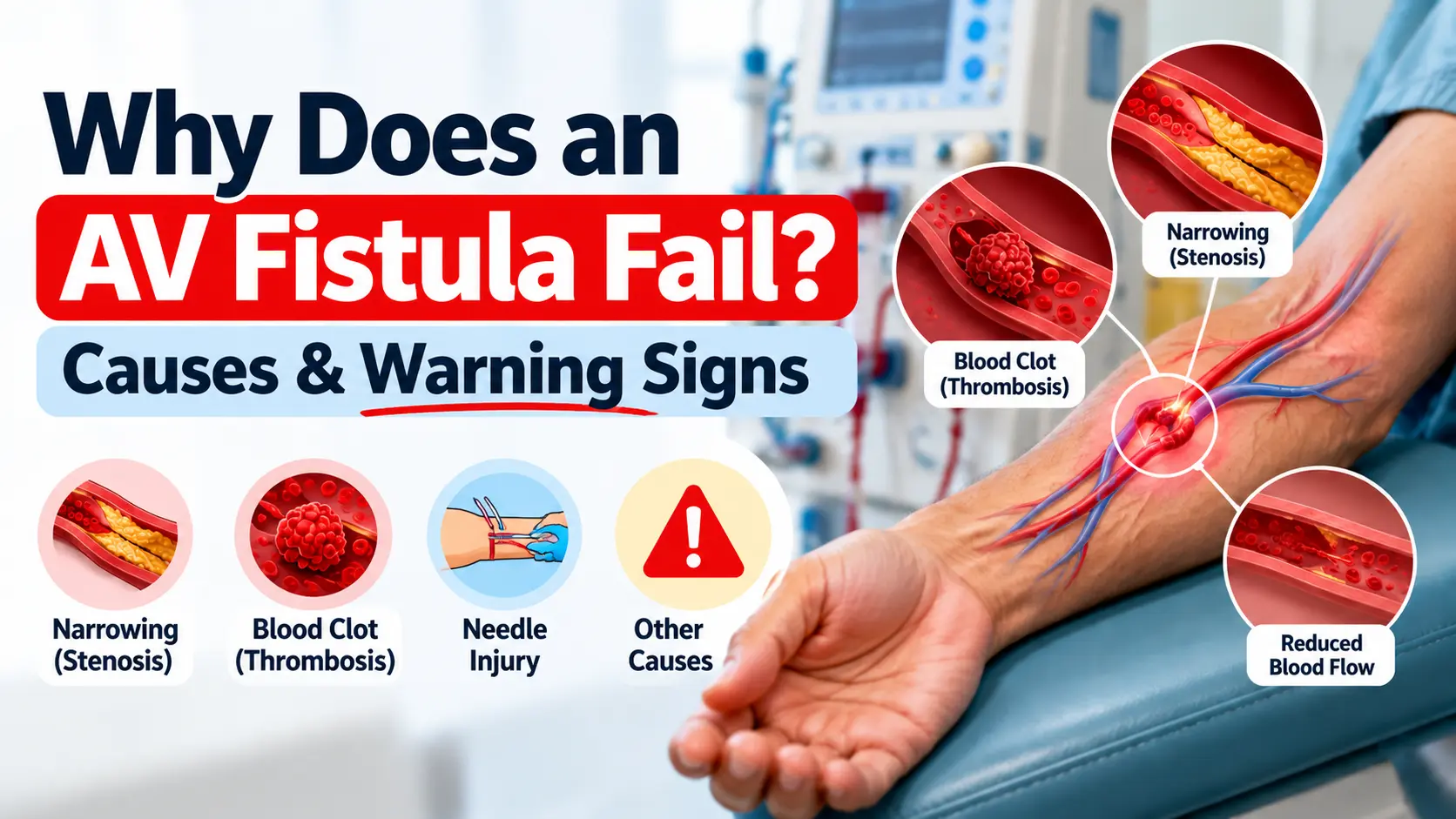
An arteriovenous (AV) fistula is created by connecting an artery to a vein so that the vein can provide reliable access for haemodialysis. Once it has matured, the fistula needs regular monitoring because problems with blood flow can develop over time.
AV fistula failure does not always happen suddenly. Narrowing, clot formation, poor maturation, repeated needle trauma, or other access problems can gradually affect how well the fistula works. Recognising changes early may allow the problem to be assessed before the access becomes completely blocked. Clinical monitoring is an important part of detecting access dysfunction and reducing the risk of thrombosis.
What Does AV Fistula Failure Mean?
AV fistula failure means the access is no longer functioning adequately for haemodialysis. This may happen because blood cannot flow through the fistula properly, the fistula does not mature sufficiently after creation, or a complication such as stenosis or thrombosis develops.
Failure can be gradual or sudden.
A gradually failing fistula may show changes in blood flow, dialysis performance, bleeding after needle removal, or the usual vibration over the access. In some cases, a clot can suddenly block the fistula and stop it from being used for dialysis.
This is why a fistula should not be considered healthy simply because it looks normal from the outside.
Why Does an AV Fistula Fail?
There is no single cause of AV fistula failure. Several problems can interfere with blood flow or damage the access over time.
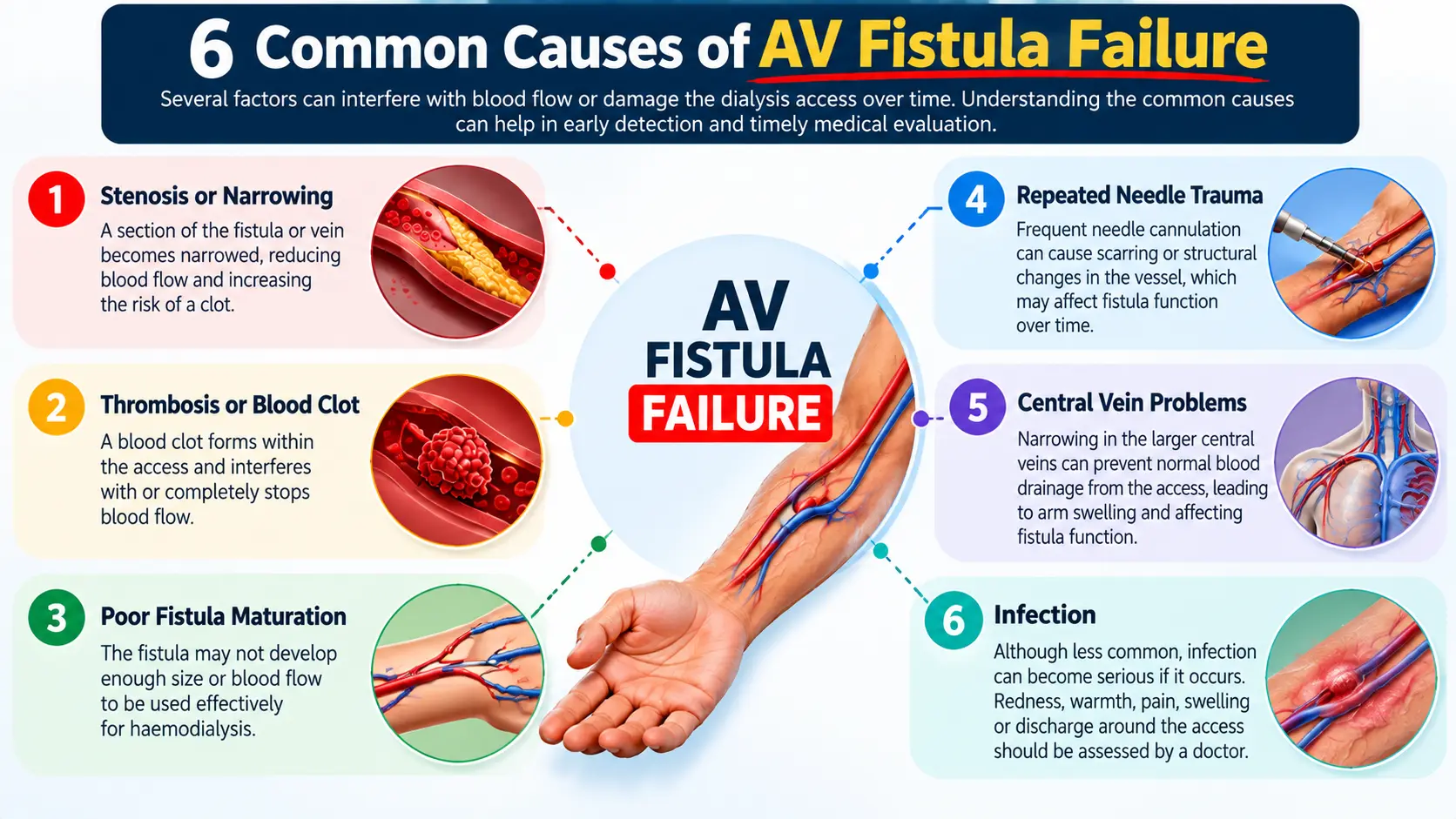
1. Stenosis or Narrowing
Stenosis means a section of the fistula or the vein carrying blood away from it becomes narrowed.
When the vessel becomes narrower, blood flow through the access can become less effective. If the narrowing becomes significant and is not addressed, it can increase the risk of thrombosis.
Changes such as reduced dialysis efficiency, abnormal pressures during dialysis, prolonged bleeding after needle removal, or changes in the physical examination can indicate possible access dysfunction.
2. Thrombosis or Blood Clot
AV fistula thrombosis occurs when a blood clot forms within the access and interferes with or completely stops blood flow.
Thrombosis can occur as a result of an underlying narrowing, although other factors can also contribute. Once the access becomes acutely thrombosed, timely assessment is important because the fistula may require an intervention to restore its function.
A blocked fistula should not be managed by waiting to see whether it starts working again. A vascular access specialist can determine whether the access can be reopened or repaired.
3. Poor Fistula Maturation
A newly created fistula needs time to develop adequate size and blood flow before it can be used reliably for haemodialysis.
Sometimes the fistula does not mature as expected. The vessels may not develop enough flow or size for effective cannulation, or a narrowing may interfere with maturation.
Poor maturation does not necessarily mean that the fistula has permanently failed. Further assessment may identify a correctable problem.
4. Repeated Needle Trauma
An AV fistula is used repeatedly for dialysis, which means the access is exposed to regular needle cannulation.
Repeated trauma at the same area can contribute to scarring or structural changes in the vessel. Proper cannulation technique and appropriate access-site management are therefore important parts of protecting the fistula over time.
5. Problems With Blood Flow From the Central Veins
The veins that carry blood away from the fistula eventually connect with the larger central veins.
If there is significant narrowing in these larger veins, blood may not drain normally from the access. This can contribute to arm swelling and affect fistula function.
Central venous problems can be particularly relevant in people who have previously required central venous dialysis catheters.
6. Infection
Infection is a less common cause of AV fistula problems, but it can become serious if it occurs.
Redness, warmth, increasing pain, swelling, discharge, or changes around the access site should be assessed by a healthcare professional. An infection involving the access requires appropriate medical management rather than home treatment.
What Are the Warning Signs of AV Fistula Failure?
The early signs of fistula dysfunction can sometimes be subtle. Patients on haemodialysis should be familiar with how their access normally feels and functions so that changes are easier to notice.
A Weak or Missing Thrill
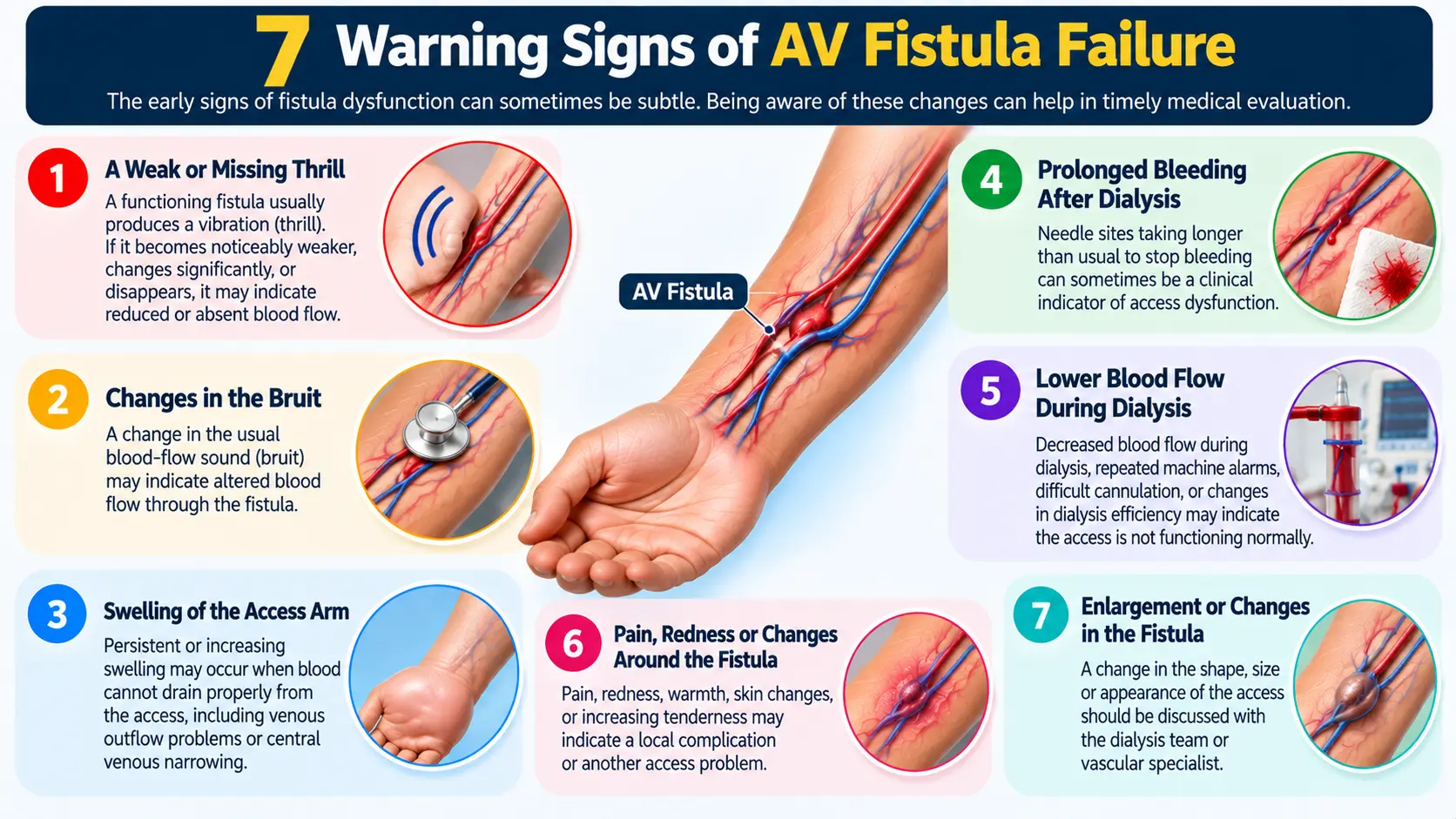
A functioning fistula usually produces a vibration, known as a thrill, that can be felt over the access.
If the thrill becomes noticeably weaker, changes significantly, or disappears, it may indicate reduced or absent blood flow.
A sudden loss of the usual thrill should be treated as an important warning sign and assessed promptly.
Changes in the Bruit
A healthcare professional can listen to the blood-flow sound, called a bruit, with a stethoscope.
A change in the usual sound may indicate altered blood flow through the fistula. This is one reason physical examination remains an important part of vascular access monitoring.
Swelling of the Access Arm
Swelling around the fistula arm can have several causes.
Persistent or increasing swelling may occur when blood cannot drain properly from the access, including in some cases of venous outflow problems or central venous narrowing.
It should not be ignored, particularly when it appears together with other changes in fistula function.
Prolonged Bleeding After Dialysis
If the needle sites consistently take longer than usual to stop bleeding after dialysis, this can sometimes be a clinical indicator of access dysfunction.
It does not automatically mean that the fistula is failing, but repeated or unexplained changes should be reported to the dialysis team for assessment.
Lower Blood Flow During Dialysis
A decrease in blood flow during dialysis, repeated machine alarms, difficult cannulation, or changes in dialysis efficiency may indicate that the access is not functioning normally.
These changes are particularly important when they are new or keep occurring over several dialysis sessions.
Pain, Redness or Changes Around the Fistula
Pain, redness, warmth, skin changes, or increasing tenderness may indicate a local complication such as infection or another access problem.
These symptoms require clinical assessment, especially if they are accompanied by swelling or changes in blood flow.
Enlargement or Changes in the Fistula
Some fistulas develop areas of enlargement over time. A change in the shape, size, or appearance of the access should be discussed with the dialysis team or vascular specialist.
Not every enlargement means the fistula has failed, but structural changes may require monitoring or treatment.
How Is AV Fistula Failure Diagnosed?
The first step is usually a clinical assessment of the access and a review of what has changed during recent dialysis sessions.
Depending on the findings, further tests may be needed.
Physical Examination
A healthcare professional may check:
The thrill and bruit
Swelling of the access arm
Skin condition
Cannulation sites
Bleeding after dialysis
Changes in the access pulse or flow
Physical examination is an important and readily available method for identifying possible AV access dysfunction.
Doppler Ultrasound
A Doppler ultrasound can assess blood flow through the fistula and help identify problems such as narrowing or abnormal flow.
It is a non-invasive investigation that may be used when clinical findings suggest that the access is not functioning normally.
Fistulogram or Angiographic Assessment
In selected cases, imaging with contrast may be needed to identify the exact location and severity of a vascular access problem, particularly when an endovascular procedure is being considered.
The appropriate investigation depends on the patient's symptoms, dialysis findings, physical examination and suspected cause.
Can a Failing AV Fistula Be Saved?
In some cases, yes.
The treatment depends on why the fistula is failing.
For example, a significant narrowing may be treated with angioplasty, while a thrombosed access may require a procedure to remove the clot and restore blood flow. Some patients may require surgical revision or reconstruction depending on the anatomy and condition of the access.
This is why identifying access dysfunction before complete thrombosis can be valuable. The KDOQI vascular access guideline describes clinical monitoring as a way to identify flow dysfunction and potentially allow treatment before thrombosis develops.
For patients with a new fistula, recurrent access problems, reduced dialysis flow, or suspected blockage, AV fistula treatment in Gurgaon can involve assessment, surveillance and appropriate interventions to preserve or restore access function.
What Should You Do If Your AV Fistula Stops Working?
If the usual thrill suddenly disappears, the access becomes significantly swollen or painful, or dialysis staff report that the fistula cannot be used properly, contact your dialysis team or treating specialist promptly.
Do not try to massage, compress, puncture, or otherwise manipulate the fistula yourself.
A blocked fistula may require urgent assessment because prolonged loss of blood flow can affect the possibility of successful access salvage.
If the fistula cannot provide adequate access for dialysis, the wider dialysis access care plan may also need to be reviewed.
How Can You Help Protect an AV Fistula?
Daily awareness and regular clinical monitoring can help identify changes early.
Patients can ask their dialysis team about the correct way to check the fistula and should follow the access-care instructions provided for their individual situation.
Some general precautions include:
Become familiar with the normal thrill of your fistula.
Report a noticeable change in the thrill or bruit.
Do not allow unnecessary blood pressure measurements or blood draws from the access arm unless specifically advised by your healthcare team.
Avoid tight clothing or pressure over the fistula.
Follow proper hygiene and cannulation instructions.
Report repeated bleeding, swelling, pain or dialysis-flow problems.
Attend recommended follow-up appointments.
The National Kidney Foundation provides dedicated guidance on AV access creation, monitoring, cannulation and management of complications, including stenosis and thrombosis.
When Should You Seek Medical Attention?
Contact your dialysis team or vascular specialist promptly if you notice:
A weak or absent thrill
A sudden change in the usual bruit
New or increasing swelling of the access arm
Persistent pain or redness
Repeated difficulty with needle placement
Reduced blood flow during dialysis
Repeated dialysis machine alarms
Prolonged bleeding after needle removal
A sudden change in the appearance of the fistula
A sudden loss of the thrill or inability to use the fistula for dialysis warrants particularly prompt attention because acute thrombosis can require intervention to restore access function.
Final Takeaway
An AV fistula is an important part of long-term haemodialysis, but it can develop problems over time. Stenosis, thrombosis, poor maturation, repeated needle trauma and other blood-flow complications can affect its function.
The key is to notice changes early. A weak or absent thrill, swelling, prolonged bleeding, reduced dialysis flow or repeated access problems should be reported rather than ignored.
If you notice a significant change in your fistula, seek timely assessment from your dialysis team or a qualified vascular specialist. Early evaluation can help determine whether the access can be treated, repaired or preserved.
Book a Consultation with Dr. Himanshu Verma
If you have noticed a weak or missing thrill, changes in blood flow during dialysis, prolonged bleeding, swelling, pain, or other changes in your AV fistula, timely evaluation is important. Dr. Himanshu Verma, a Vascular & Endovascular Surgeon at Fortis Memorial Research Centre, Gurugram, provides evaluation and treatment for vascular access problems, including AV fistula complications.
Patients from Gurgaon, Delhi NCR, Noida, Faridabad, and nearby areas can seek specialist evaluation for suspected AV fistula dysfunction or other dialysis access concerns. The appropriate assessment and treatment plan depends on the condition of the fistula, clinical findings, dialysis-related changes, and relevant test results.
Call:+91 88268 33598
Email:varenyamvascular@gmail.com
Visit:Fortis Memorial Research Centre, Opposite HUDA City Centre, Sector 44, Gurugram, Haryana 122003
If you are concerned about changes in your AV fistula or dialysis access, timely medical evaluation can help determine the appropriate next step