Vascular Specialist · Gurgaon
Chronic Venous Insufficiency Treatment in Gurgaon
Feeling tired or heavy in your legs by evening? Early consultation for CVI Treatment in Gurgaon can help prevent the condition from worsening.
4 Stages
Disease Progression
5 Treatments
Available Options
Early Care
Best Outcomes
What is Chronic Venous Insufficiency?
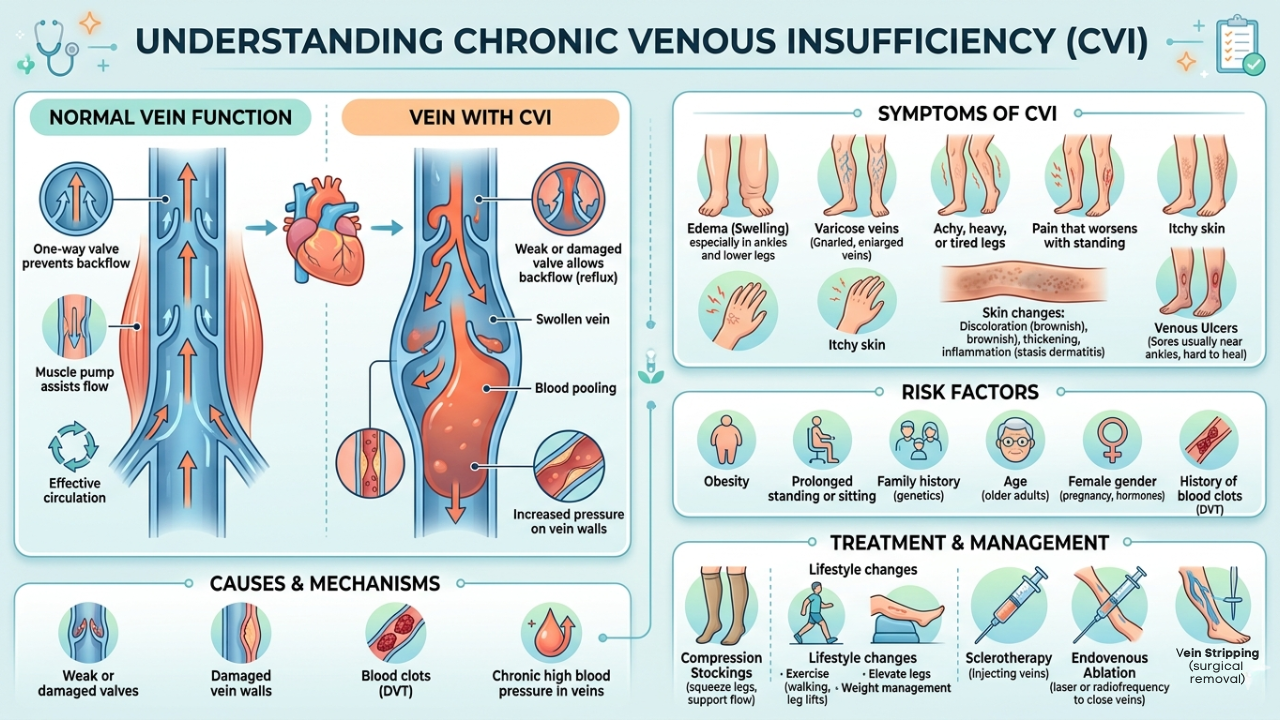
Chronic venous insufficiency (CVI) is a long-term vascular condition in which the veins in your legs are unable to return blood to the heart efficiently. Inside a healthy vein, small one-way valves open to allow blood to flow upward and close to stop it falling back. When these valves weaken or become damaged, blood flows backward and pools in the lower leg, a process called venous reflux. Over time, this sustained pooling raises the pressure inside the veins, progressively damaging the vein walls, surrounding skin, and deeper tissues of the leg.
CVI is not a cosmetic problem. It is a chronic, progressive medical condition that worsens without treatment. Untreated CVI is one of the leading causes of venous leg ulcers - wounds that can take months to heal and significantly reduce quality of life. Many patients who seek chronic venous insufficiency treatment in Gurgaon have been managing symptoms for years without knowing the underlying cause.
How Does Chronic Venous Insufficiency Affect the Body?
When venous pressure remains persistently elevated, the following changes occur in the lower limb:
This progression is why early diagnosis matters. The earlier the condition is identified, the simpler and more effective the treatment.
Symptoms & Causes
What are the signs and symptoms of chronic venous insufficiency?
Recognising the signs and symptoms of chronic venous insufficiency at an early stage is the single most important factor in preventing disease progression. Many patients normalise symptoms like leg heaviness after standing, mild ankle swelling, or persistent itching - as routine tiredness. They are not. They are the body's earliest warning signals of venous disease, and acting on them before skin changes or ulcers develop leads to significantly better outcomes.
Signs and Symptoms of Chronic Venous Insufficiency
There are several common symptoms of Chronic Venous Insufficiency:
- Persistent heaviness, aching, or fatigue in the legs worse after prolonged standing or sitting
- Swelling in the ankles and lower legs, particularly by end of day
- Burning, itching, or throbbing sensation around the lower leg or ankle
- Visible varicose veins or dilated surface veins
- Skin discolouration - brownish or reddish staining near the ankles
- Hardening or tightening of the skin around the lower leg (lipodermatosclerosis)
- Nighttime leg cramps and restless legs
- Slow-healing wounds or open ulcers near the ankle
- A feeling of tightness in the calf when walking
Venous ulcers (open sores) are a sign of advanced Chronic Venous Insufficiency.
What Causes Chronic Venous Insufficiency?
Chronic Venous Insufficiency usually arises as a result of any of the following:
- Damaged or weakened vein valves - the primary underlying cause
- Previous deep vein thrombosis (DVT) - clots can permanently damage valve function
- Genetics and family history of venous disease
- Prolonged standing or sitting - occupational risk for teachers, healthcare workers, IT professionals, and retail staff
- Pregnancy - increased venous pressure and hormonal changes affect valve competence
- Obesity - sustained excess pressure on the venous system
- Aging - progressive weakening of vein wall elasticity and valve function
- Sedentary lifestyle - reduced calf muscle pump activity essential for venous return
Understanding the root cause helps doctors recommend the most suitable CVI Treatment in Gurgaon for long-term vein health.
If you can relate to any of these symptoms, seeking Chronic Venous Insufficiency Treatment in Gurgaon early can help slow down the progression of the disease and improve leg health.
Disease Progression
What Are the Stages of Chronic Venous Insufficiency?
The stages of chronic venous insufficiency are classified using the internationally recognised CEAP grading system from C0 (no visible signs) to C6 (active venous ulcer). Understanding your stage determines the most appropriate treatment and how urgently it is needed.
Treating CVI at stage C2 or C3 usually requires one outpatient session with same-day discharge.
Treating it at C6 requires weeks of wound care and multiple procedures.
The decision to seek early evaluation is, in almost every case, the most important one a patient will make.
What Are the Serious Complications of Untreated CVI?
When left without treatment, the sustained increase in venous pressure progressively damages the leg:
Early intervention prevents all of these outcomes. Do not wait until symptoms worsen.
How Is Chronic Venous Insufficiency Diagnosed?
Accurate diagnosis defines the stage, identifies the underlying venous anatomy, and guides every treatment decision. Dr. Himanshu Verma conducts a structured, stepwise assessment for every patient.
Clinical Examination
A thorough physical assessment of both legs in the standing position. Dr. Himanshu evaluates the distribution of varicosities, skin changes, oedema, and any areas of ulceration or wound breakdown.
CEAP Classification
Each patient is formally graded using the CEAP system (C0 to C6) to determine disease severity and prioritise the type and urgency of intervention required.
Venous Duplex Doppler Ultrasound
The gold standard diagnostic tool for CVI. This painless 20-minute scan maps the entire venous system of the leg — identifying where valves are failing, quantifying venous reflux, ruling out deep vein thrombosis, and confirming the anatomy needed to plan treatment.
Results are available the same day. No hospital admission required.
Venography or CT Venogram (if indicated)
In complex or recurrent cases, or where deep venous obstruction is suspected, advanced imaging is arranged to provide a complete anatomical picture before treatment planning.
Personalised Treatment Plan
A fully individualised treatment plan is prepared based on all findings — taking into account disease stage, symptom burden, lifestyle, occupation, and the patient's own goals.
Treatment Pathways
Chronic Venous Insufficiency Treatment in Gurgaon - Available Options
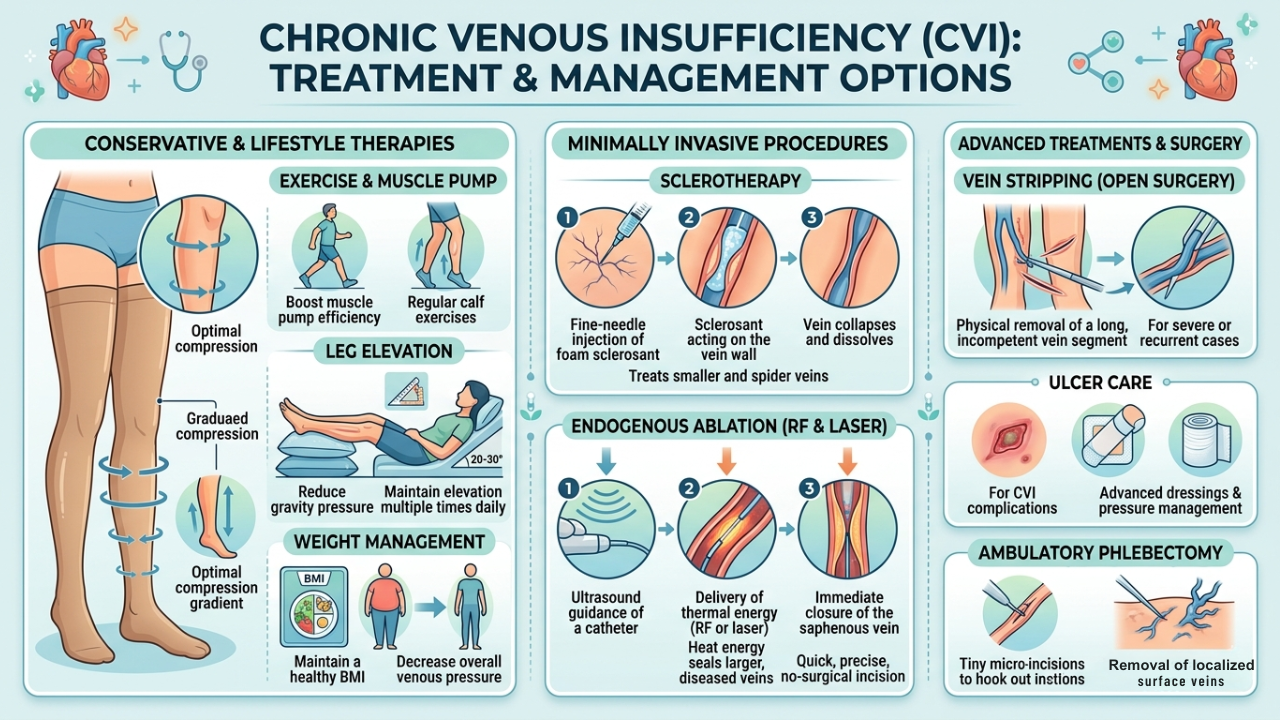
CVI is a progressive condition, but it is highly treatable particularly when addressed before reaching advanced stages. Every patient receives a personalised treatment plan based on their CEAP stage, Doppler findings, symptom severity, lifestyle, and goals. All procedures are minimally invasive, performed under local anaesthesia, and require no overnight hospital stay.
Treatment Options for Chronic Venous Insufficiency
Treatment is selected based on the stage of disease, the pattern of venous reflux, symptom severity, and the patient’s lifestyle needs.
Compression Therapy
First-Line ManagementMedical-grade compression stockings apply graduated external pressure to the leg, reducing venous pooling, controlling oedema, and slowing disease progression. Used at all stages — alone for early CVI or alongside procedural treatment for moderate to advanced cases.
EVLT — Endovenous Laser Treatment
Most Effective for RefluxLaser energy delivered through a thin fibre permanently seals the incompetent superficial vein, eliminating the source of venous reflux that drives CVI progression.
RFA — Radiofrequency Ablation
Most ComfortableRadiofrequency energy delivered via a catheter heats and permanently closes the refluxing vein wall. Equally effective to EVLT with excellent patient comfort.
Foam Sclerotherapy
Spider & Smaller VeinsA foam solution injected into smaller varicose or reticular veins causes the vein wall to collapse and be absorbed naturally. Also used for residual veins following ablation.
Venous Ulcer Management
Advanced CVI — C5 & C6For patients with active or recurrent venous ulcers, treatment combines wound care, compression therapy, correction of the underlying venous reflux, and nutritional support. Correcting the reflux source is essential — without it, ulcers cannot close permanently.
Treatment Comparison at a Glance
Risks and What to Expect
All procedures are safe and well-tolerated. Patients should be aware of the following:
Mild bruising, swelling, or tightness along the treated vein — usually resolves within 1–2 weeks. Skin discolouration from sclerotherapy typically fades over 2–6 months.
Superficial phlebitis managed with anti-inflammatory medication; small areas of temporary numbness near the treated vein.
Partial vein recanalisation; infection at the access site; deep vein thrombosis — risk minimised through pre-procedural Doppler screening and early post-procedure mobilisation.
Seek urgent medical attention if you experience sudden leg pain with swelling, chest pain, or shortness of breath following any procedure.
Dr. Himanshu Verma reviews each patient's individual risk profile in full before any treatment is recommended.
When Chronic Venous Insufficiency is identified early and managed with proper Chronic Venous Insufficiency Treatment in Gurgaon, it can significantly reduce the risk of complications.
With the right Chronic Venous Insufficiency Treatment in Gurgaon, patients can experience improved mobility, reduced swelling, and better overall quality of life.
Trusted Vascular Specialist
Why Choose Dr. Himanshu Verma for Chronic Venous Insufficiency Treatment in Gurgaon?
Choosing the right vascular surgeon in Gurgaon is one of the most important decisions in your treatment journey. Dr. Himanshu Verma is among India's experienced vascular and endovascular surgeons with a dedicated subspecialty focus on chronic venous and lymphatic disorders.
Practising At
Fortis Memorial Research Institute, Sector 44, Gurgaon — accredited by both NABH and JCI, representing India's highest standards for hospital safety and clinical quality.
Qualifications & Memberships
MBBS, MS, MCh (Vascular Surgery) — Board-Certified Vascular & Endovascular Surgeon
Fellow, European Venous & Lymphatic Society (FEVS)
Member, Vascular Society of India (VSI)
Clinical Expertise
Specialist in EVLT, RFA, Foam Sclerotherapy, Compression Therapy, and Venous Ulcer Management
Expert in recurrent and post-thrombotic chronic venous insufficiency
Dedicated focus on complex venous and lymphatic disorders
Extensive experience in minimally invasive endovascular procedures
Research & Academic Recognition
29+ peer-reviewed publications in indexed medical journals
9 authored book chapters on vascular surgery
International speaker — VEITH Symposium, New York
Research referenced in clinical practice guidelines across India
What Our Patients Say
Patients treated for chronic venous insufficiency, venous ulcers, and advanced varicose vein disease share their recovery experiences after treatment by Dr. Himanshu Verma.
"I had been told my leg swelling and skin discolouration were just signs of aging. Dr. Himanshu diagnosed CVI within the first visit and explained exactly what was happening inside my veins. After EVLT, the swelling reduced within two weeks. I wish I had come sooner."
Arun K.
Retired School Principal, Gurgaon
"I had a venous ulcer on my left ankle for nearly eight months. Multiple dressings had failed to close it. Dr. Verma identified the reflux source on Doppler and treated it with RFA. The ulcer was fully healed within six weeks. I cannot overstate how much this changed my life."
Meena T.
Homemaker, Faridabad
"As a surgeon myself, I was very careful about who I chose for my own CVI treatment. Dr. Himanshu's diagnostic thoroughness and procedural precision are exceptional. His knowledge of venous disease is among the best I have encountered anywhere."
Dr. Sanjeev R.
Orthopaedic Surgeon, Delhi
Rated 4.9 / 5
Based on 300+ verified Google reviews
Common Questions
Frequently Asked Questions
The signs and symptoms of chronic venous insufficiency include persistent leg heaviness and aching, ankle swelling that worsens through the day, burning or itching around the lower leg, visible varicose veins, skin discolouration or hardening near the ankle, nighttime cramps, and in advanced cases, slow-healing ulcers near the ankle. Many patients experience these symptoms for months or years before seeking evaluation — early assessment always leads to better outcomes.
CVI is staged using the CEAP classification from C0 (no visible signs) to C6 (active venous ulcer). The stage determines the urgency and type of treatment required. Most patients presenting for treatment are at stages C2 to C4, where a single minimally invasive procedure provides excellent and lasting results.
Varicose veins are a visible manifestation of venous valve failure. Chronic venous insufficiency is the underlying condition causing them — along with swelling, skin changes, and ulcers. Not all CVI patients have prominent varicose veins, but the underlying venous dysfunction is the same. Both conditions are assessed and treated by Dr. Himanshu Verma.
Diagnosis involves a clinical examination, CEAP staging, and a Venous Duplex Doppler Ultrasound — the gold standard investigation that maps valve function, measures reflux, and rules out deep vein thrombosis. Results are available the same day. No hospital admission is required for the diagnostic assessment.
Yes. Chronic venous insufficiency treatment in Gurgaon — including EVLT and Radiofrequency Ablation — is covered under most major health insurance plans in India, including Mediclaim. Our team assists with pre-authorisation and documentation before your procedure.
Most procedural treatments are completed in 30–60 minutes under local anaesthesia with same-day discharge. Patients walk out unassisted. Compression therapy is an ongoing management strategy used alongside or instead of procedures depending on disease stage.
Treated veins are permanently sealed and the reflux driving your symptoms is eliminated. However, CVI is a systemic tendency of the venous system — new insufficiency can develop over time, particularly if underlying risk factors are not addressed. Lifestyle modification and annual follow-up with Doppler assessment significantly reduce long-term recurrence.
Seek evaluation as soon as you notice persistent leg swelling, skin discolouration near the ankle, varicose veins causing discomfort, or any wound that is not healing. At early stages, CVI is straightforward to treat — the best outcomes consistently follow prompt evaluation.
Prevention & Recovery
Protect Your Long-Term Leg Health
Evidence-based daily habits that reduce CVI progression and support long-term outcomes after treatment.
Walk Daily
Walk for 20–30 minutes every day - the calf muscle acts as the body's natural venous pump and improves blood return from the legs.
Elevate Your Legs
Elevate your legs above heart level for 15 minutes daily, especially after prolonged standing or sitting.
Wear Compression Stockings
Use prescribed compression stockings consistently - compliance directly affects treatment success and symptom control.
Maintain Healthy Weight
Maintaining a healthy body weight reduces sustained pressure on the venous system and slows disease progression.
Avoid Prolonged Sitting or Standing
Take a movement break every 30–45 minutes if your work involves prolonged sitting or standing.
Long-term success in chronic venous insufficiency treatment depends not only on the procedure itself, but also on maintaining healthy venous circulation habits after treatment.
Take Action Before Symptoms Progress
Early diagnosis and timely treatment can prevent long-term vein damage and improve quality of life.
Hospital & Clinic
Dr. Himanshu Verma
Vascular & Endovascular Surgeon
Fortis Memorial Research Institute
Sector 44, Opposite HUDA City Centre Metro Station
Gurgaon, Haryana — 122002
Consultation Details
NABH & JCI Accredited Hospital
OPD: Monday to Saturday, 9:00 AM – 5:00 PM
Nearest Metro: HUDA City Centre (Yellow Line)