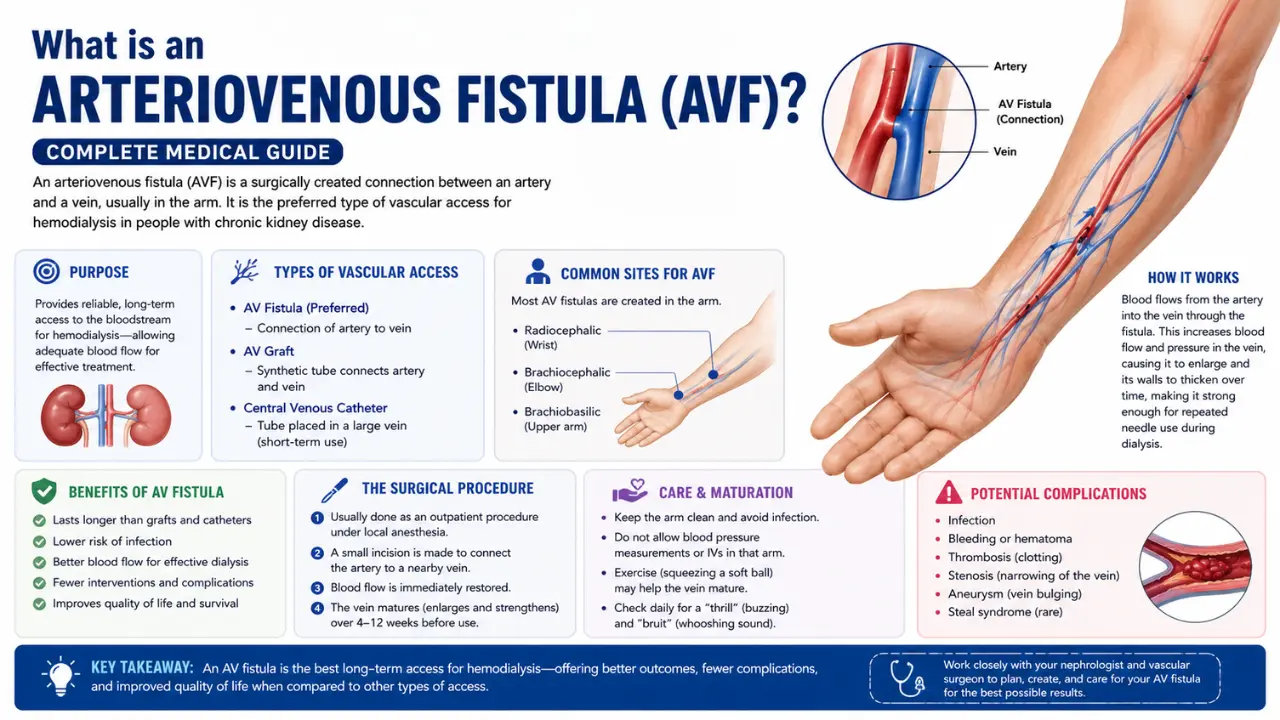
If your doctor has mentioned dialysis and keeps bringing up something called an arteriovenous fistula, you are not alone in feeling confused. At his vascular surgery clinic at Fortis Memorial Research Centre, Gurugram, Dr. Himanshu Verma answers this exact question every single day. This guide explains everything in plain, simple language.
An arteriovenous fistula (or AV fistula) is a surgically created connection between an artery and a vein, usually in your forearm. Arteries carry blood at high pressure; veins are softer and have low pressure. When the two are joined, high-pressure blood flows into the vein, causing it to grow larger and stronger over time. This process is called fistula maturation, and it usually takes 6 to 12 weeks. Once mature, the fistula becomes the ideal hemodialysis access point for your dialysis machine
Why is an AV Fistula Necessary for Dialysis?
Dialysis machines need to process 300 to 500 ml of blood per minute. Ordinary arm veins cannot handle this without collapsing. An arteriovenous fistula creates a toughened, enlarged vein that can safely support dialysis three times a week, for many years. The alternatives, catheters and grafts, are either risky or shorter-lasting.
Feature | AV Fistula | Graft | Catheter |
|---|---|---|---|
Lifespan | Many years | 3-5 years | Months |
Infection Risk | Very Low | Moderate | High |
Best For | Long-term | Weak veins | Short-term only |
Key Benefits of AV Fistula Over a Catheter
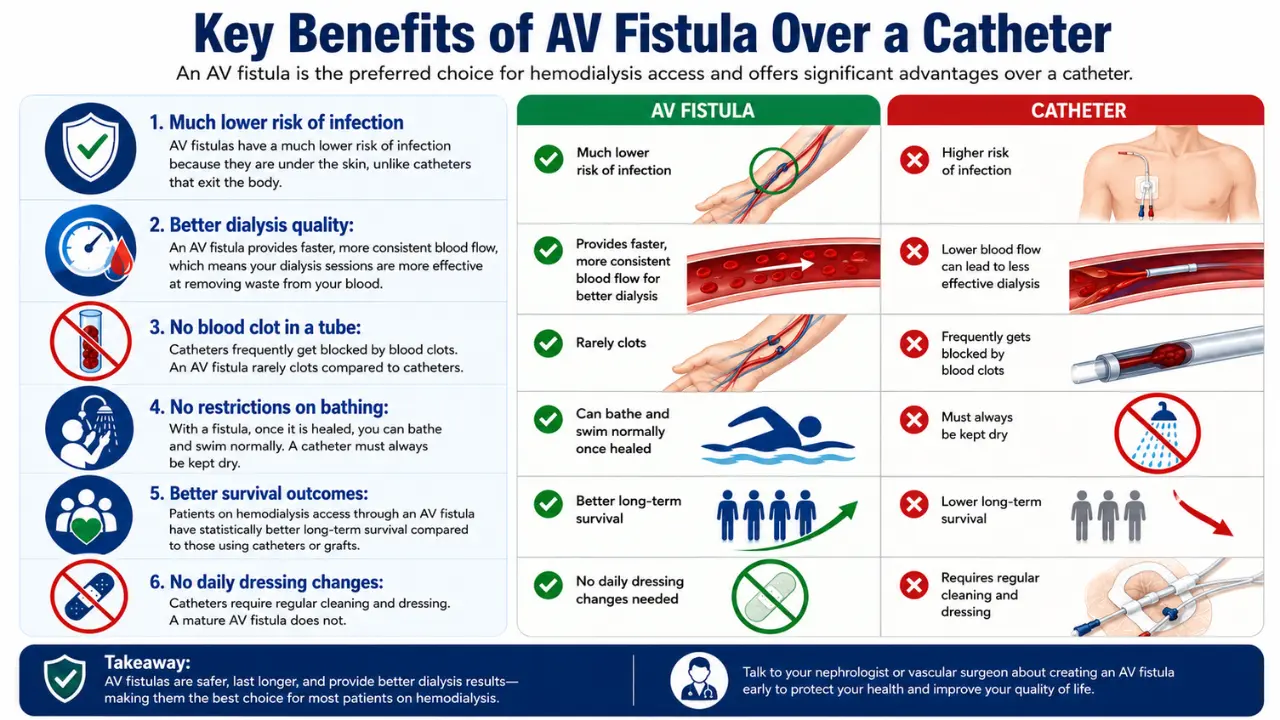
Many patients come to Dr. Himanshu Verma already on a dialysis catheter, and they often feel relatively comfortable with it because it is already there and they are used to it. But a catheter, while useful in emergencies and for short-term use, is not a safe long-term solution. Here is why an AV fistula is strongly preferred:
Much lower risk of infection: A catheter exists through the skin and is constantly exposed to bacteria. AV fistulas are entirely under the skin and have a dramatically lower risk of life-threatening bloodstream infections.
Better dialysis quality: An AV fistula provides faster, more consistent blood flow, which means your dialysis sessions are more effective at removing waste from your blood.
No blood clot in a tube: Catheters frequently get blocked by blood clots. An AV fistula rarely clots compared to catheters.
No restrictions on bathing: With a fistula, once it is healed, you can bathe and swim normally. A catheter must always be kept dry.
Better survival outcomes: Patients on hemodialysis access through an AV fistula have statistically better long-term survival compared to those using catheters or grafts.
No daily dressing changes: Catheters require regular cleaning and dressing. A mature AV fistula does not.
When Should You Create an Arteriovenous Fistula?
This is where early planning saves lives. One of the most common and most unfortunate situations Dr. Himanshu Verma sees in his clinic is a patient who arrives needing to start dialysis immediately, with no Arteriovenous Fistula in place. This forces the patient to use a catheter urgently, which carries all the risks mentioned above.
The ideal time to create an AV fistula is at least 3 to 6 months before you are expected to need dialysis. Why so early? Because the fistula needs time to mature. Fistula maturation is the process by which the vein wall thickens, the diameter increases, and blood flow becomes strong enough to support dialysis. This process cannot be rushed.
How Do You Know Your Fistula is Working?
After your AV fistula surgery, two things tell your doctor and you that the fistula is functioning as it should. These are called the bruit and thrill.
Thrill: When you gently place your fingers over the fistula site, you should feel a gentle vibration or buzzing. This is caused by blood flowing from the high-pressure artery into the vein. This is the thrill, and feeling it is a good sign.
Bruit: When a doctor places a stethoscope over the fistula, they hear a swishing or whooshing sound. This is the bruit. If the bruit disappears or sounds different, it may indicate a blockage or narrowing that needs attention.
You will be taught how to check for the thrill at home. Dr. Himanshu Verma and his team make sure every patient leaves with clear instructions on how to monitor their fistula daily.
Two things confirm a working Arteriovenous Fistula. The thrill is a gentle buzzing you feel when you place your fingers over the fistula. The bruit is a whooshing sound a doctor hears with a stethoscope. Check for the thrill every single day. If you cannot feel it, call your vascular surgeon immediately.
Caring for Your AV Fistula: Do's and Don'ts
Do's
• Check the thrill every morning
• Keep the arm clean and the skin moisturized
• Do squeeze-ball exercises to help the fistula mature faster
• Inform all medical staff that your fistula arm must not be used for BP or blood draws
Don'ts
• Never allow blood pressure readings or injections on the fistula arm
• Do not sleep with pressure on that arm
• Avoid tight watches, bracelets, or tight sleeves on the fistula arm
• Do not ignore swelling, pain, or loss of the thrill
What Are the Possible Fistula Complications and How Are They Treated?
Even with proper care, an arteriovenous fistula can sometimes develop problems. These fistula complications are usually treatable if caught early, which is yet another reason why regular follow-up is so important. The most common complications include:
Thrombosis (clotting): The fistula becomes blocked by a blood clot. This is usually treated by a procedure called thrombectomy or by interventional radiology techniques such as catheter-directed thrombolysis.
Stenosis (narrowing): The vein or the connection point becomes narrow, reducing blood flow. This is treated with a procedure called balloon angioplasty, done by an interventional radiology specialist.
Venous hypertension: When blood from the fistula cannot drain efficiently, pressure builds up in the veins of the hand, causing swelling, pain, and skin discoloration. This may require surgical correction.
Aneurysm: A section of the fistula vein balloons outward due to repeated needle insertions. Small aneurysms are monitored. Large or complicated ones may need surgical repair.
Steal syndrome: In some cases, the fistula diverts so much blood from the artery that the hand does not get enough circulation, causing coldness, pain, or weakness. This requires prompt surgical attention.
Infection: Though rare in AV fistulas compared to catheters, infections can occur and need to be treated aggressively with antibiotics and sometimes surgery.
Why Early Planning for an AV Fistula Can Change Everything
If there is one thing Dr. Himanshu Verma wants every patient with chronic kidney disease to understand, it is this: please do not wait until the last minute.
When a patient is referred too late and has to start dialysis urgently, the only option is an emergency dialysis catheter placed in the neck or chest. This catheter carries a significant risk of serious infection, clotting, and poor dialysis quality. It is uncomfortable, it restricts your activities, and it requires constant maintenance.
In contrast, a patient who plans gets their AV fistula created 3 to 6 months before dialysis is needed. By the time they need hemodialysis access, their fistula is mature, working well, and ready to go. They start dialysis on day one with a comfortable, reliable, long-lasting access point.
Early planning also gives the surgeon more options. If the first fistula attempt needs time or requires an additional procedure, there is still time to make adjustments before dialysis starts. This is not possible when a patient arrives in crisis.
Take the First Step Toward Safer Dialysis Access
If you or your loved one has been advised dialysis, don’t wait until it becomes an emergency. Early planning for an arteriovenous fistula can significantly improve your treatment quality, reduce risks, and give you a safer, long-term dialysis solution.
Consult with Dr. Himanshu Verma, an experienced vascular specialist offering advanced care for dialysis access, peripheral artery disease, varicose veins, and comprehensive vascular conditions.
Call Now: 88268 33598
Email: varenyamvascular@gmail.com
Visit Clinic: Fortis Memorial Research Institute, Opposite HUDA City Centre, Sector 44, Gurugram, Haryana 122003
Don’t wait for complications to arise. Plan early, get the right access, and ensure better outcomes. Book your consultation today and explore other services, including PAD treatment, vein care, diabetic foot management, and complete vascular health support.
In Conclusion: Your AV Fistula is Your Lifeline
An arteriovenous fistula is not just a medical device or a surgical procedure. For patients who need long-term dialysis, it is a lifeline that directly affects how well they live, how safely they are treated, and how long they survive. Understanding what an AV fistula is, why it matters, when to create it, and how to care for it can make an enormous difference in your quality of life.
The key takeaways from this guide are simple. Plan early. Protect your fistula. Monitor it daily. Follow your surgeon's instructions. And if anything feels wrong, do not wait.
Remember: not all patients need surgery, and treatment always depends on your personal condition. If you have any concerns about your kidney health, your dialysis access, or your arteriovenous fistula, Dr. Himanshu Verma and his team at Varenyam Vascular are just one phone call away.