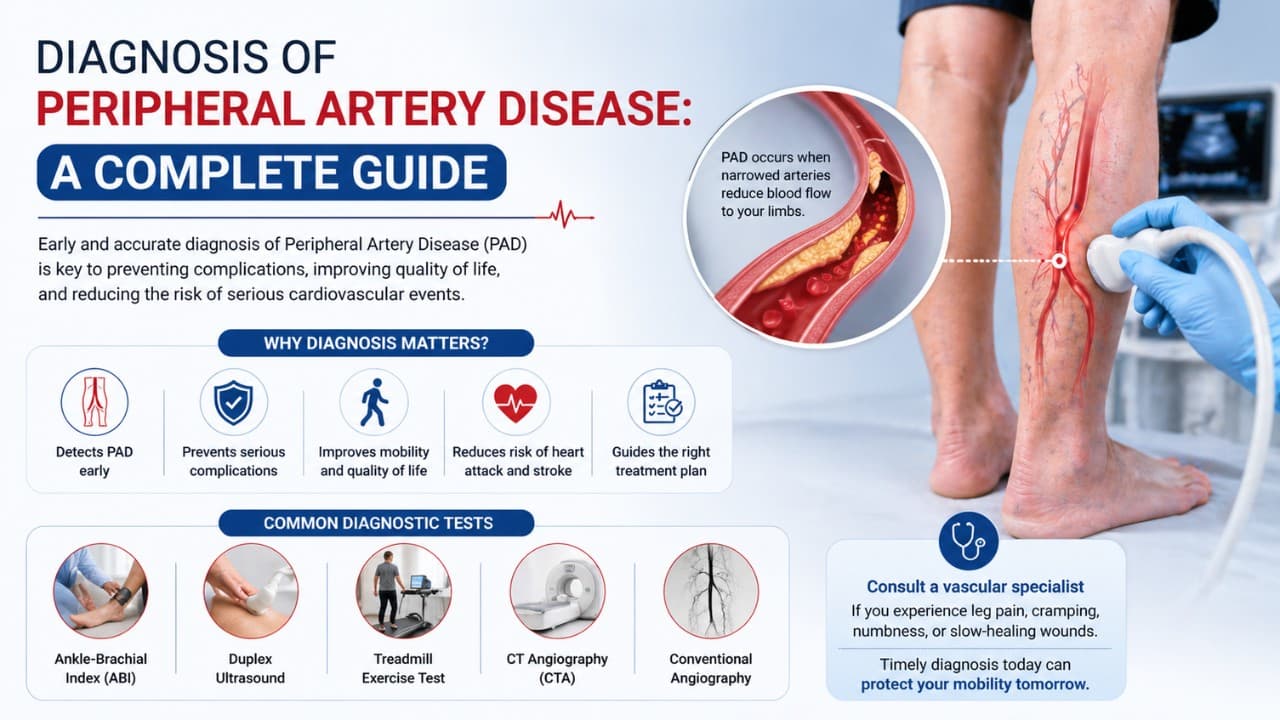
If your legs feel unusually tired after walking a short distance, or you notice pain that goes away when you rest, your body might be trying to tell you something important. These signs could point toward a condition called Peripheral Artery Disease (PAD). The good news is that the diagnosis of Peripheral Artery Disease is straightforward, painless in most cases, and a specialist like Dr. Himanshu Verma, a vascular healthcare expert and Peripheral Artery Disease Treatment in Varanasi, can walk you through with care and clarity.
This guide is written for you, the patient, or perhaps someone who loves a patient. Not for doctors. Not for medical textbooks. For real individuals seeking real solutions.
What Is Peripheral Artery Disease and Why Does It Need to Be Diagnosed Early?
Peripheral Artery Disease is a blood flow issue where narrowed arteries, caused by a buildup of fatty plaque (atherosclerosis), reduce blood flow to the limbs, most commonly the legs. When blood flow is reduced, your legs and feet do not receive enough oxygen-rich blood for everyday activity. Left undetected, PAD can lead to non-healing wounds, tissue damage, and in severe cases, limb loss, making early Diagnosis of Peripheral Artery Disease essential.
PAD is also closely linked to a higher risk of heart attack and stroke, since the same plaque buildup affecting leg arteries can affect those supplying the heart and brain. A proper Diagnosis of Peripheral Artery Disease does not just protect your legs. It can protect your heart too.
How Is Peripheral Artery Disease Diagnosed? An Overview
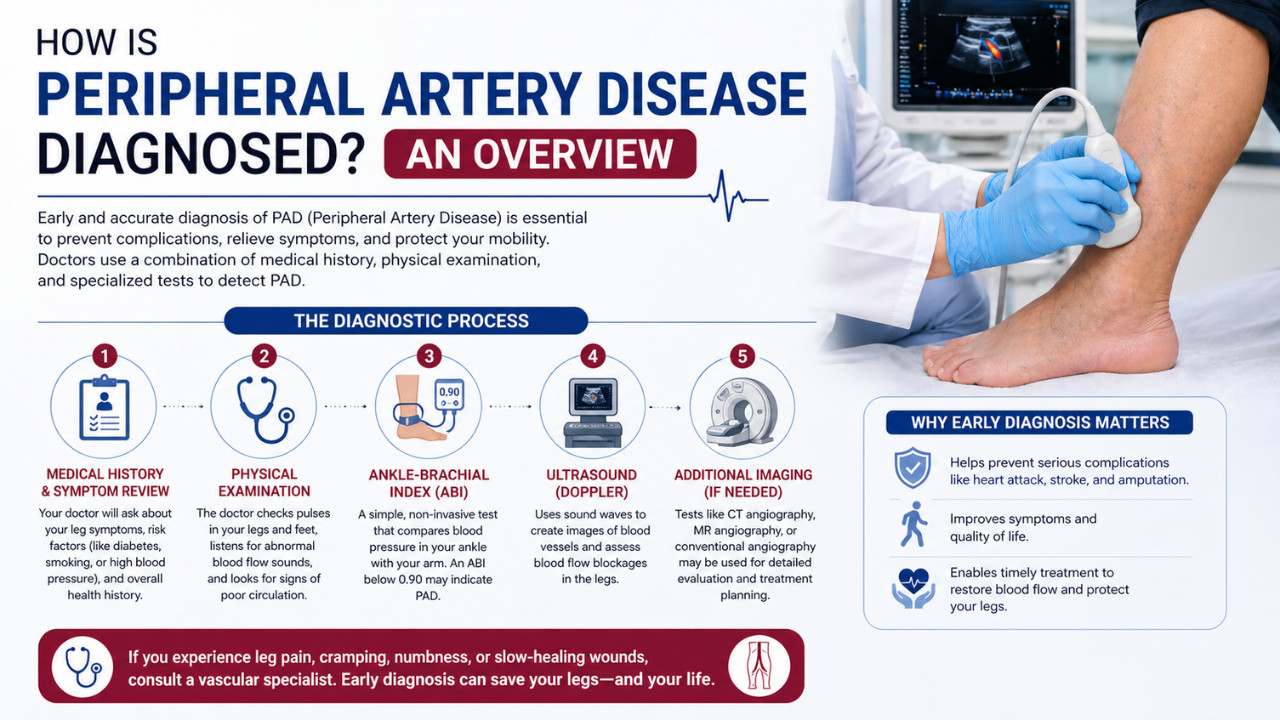
The diagnosis of Peripheral Artery Disease involves a combination of a thorough clinical examination and targeted diagnostic tests. These tests are designed to assess blood flow through the arteries, identify where blockages exist, and determine how severe those blockages are. Diagnosis includes:
 Clinical Examination
Every Diagnosis of Peripheral Artery Disease starts with a face-to-face clinical examination. This is where your doctor listens to your story, asks about your symptoms, and physically examines your body to look for early signs of reduced blood flow.
A clinical examination alone does not confirm PAD, but it gives your doctor important clues and helps determine which tests to order next. Dr. Himanshu Verma places great importance on this first consultation. He believes that understanding a patient's story is just as important.
ABI Test (Ankle-Brachial Index)
If there is one test that is considered the cornerstone of the Diagnosis of Peripheral Artery Disease, it is the Ankle-Brachial Index (ABI) test. It is simple, non-invasive, painless, and highly informative.
The ABI test compares blood pressure measured at the ankle to blood pressure measured at the arm (brachial artery). Since blood pressure at the ankle should normally be equal to or slightly higher than blood pressure at the arm, a significantly lower reading at the ankle suggests that blood flow to the leg is being blocked somewhere along the way.
Doppler Ultrasound: Seeing Blood Flow in Real Time
Once the ABI test raises concern, the next step in the diagnosis of Peripheral Artery Disease is often a Doppler ultrasound scan. This imaging technique allows doctors to actually visualize blood flow through the arteries and identify exactly where narrowing or blockage is occurring.
What Is Doppler Ultrasound?
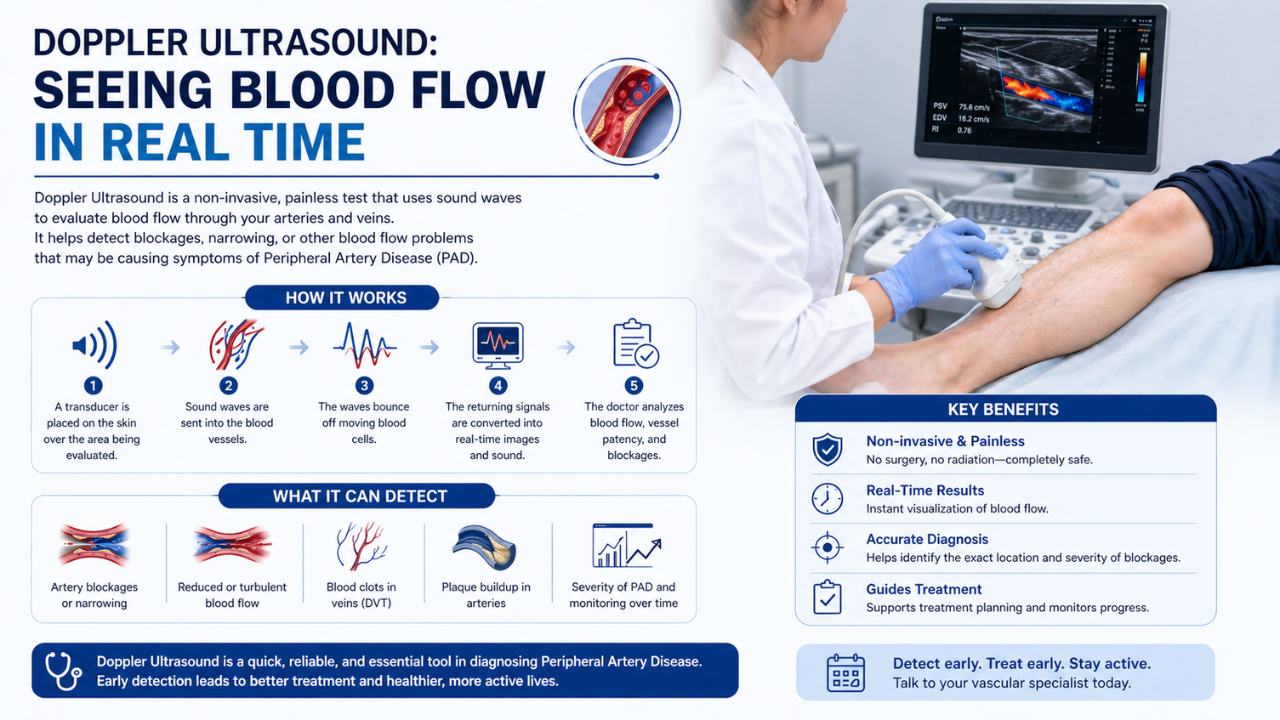 Doppler ultrasound uses sound waves to create real-time images of blood moving through arteries and plays an important role in the Diagnosis of Peripheral Artery Disease. It can show the speed and direction of blood flow, and it can highlight areas where the blood flow is turbulent, reduced, or absent, all significant symptoms of PAD.
There are two types commonly used:
- Duplex ultrasound: Combines standard ultrasound imaging with Doppler flow measurement. It gives a two-dimensional picture of the artery alongside information about blood flow.
- Color flow Doppler: Adds color coding to show the direction and speed of blood flow, making it easier to spot blockages visually.
Benefits of Doppler Ultrasound in PAD Diagnosis:
- Non-invasive and painless, making it a comfortable step in the Diagnosis of Peripheral Artery Disease
- No radiation exposure
- Can be done in a clinic setting
- Provides precise location and extent of blockage
- Helps plan treatment, whether medical management, angioplasty, or bypass surgery is needed
CT Angiography
For selected patients, particularly those being considered for surgical intervention or when the Doppler results are inconclusive, CT angiography offers a detailed roadmap of the arterial system and supports a more precise Diagnosis of Peripheral Artery Disease.
When Is CT Angiography Used in PAD?
- Before planning a surgical bypass or endovascular procedure
- When a Doppler ultrasound does not provide a clear enough picture
- In patients with severe or multi-level disease, knowing the exact anatomy is critical
- When there is concern about the involvement of the aorta or iliac vessels
Despite its limitations, CT angiography remains one of the most informative tools in the diagnosis of Peripheral Artery Disease for patients who need surgical planning. Dr. Himanshu Verma carefully selects this investigation based on each patient's clinical situation.
When Should You See a Doctor?
You should seek evaluation for PAD if you experience:
- Leg pain or cramping that comes on with walking and goes away with rest
- Leg pain that wakes you up at night (a sign of more severe PAD)
- Ulcers or wounds on your legs or feet that don't heal
- Cold, pale, or discolored feet
- You are over 50 and have diabetes or a history of smoking
- A healthcare provider has mentioned that your leg pulses are weak or absent
Do not dismiss these symptoms of PAD as just getting older or normal tiredness. They deserve proper evaluation. Early diagnosis of Peripheral Artery Disease is a genuine lifesaver.
If you are concerned about your leg symptoms, reach out to Dr. Himanshu Verma's clinic today for a comprehensive vascular assessment.
Take the First Step Toward Accurate PAD Diagnosis
If you are experiencing leg pain, cramping while walking, or unusual changes in your feet or skin, don’t ignore these warning signs. Early diagnosis of Peripheral Artery Disease can help prevent serious complications and protect both your limb and heart health.
Dr. Himanshu Verma is a vascular specialist known for his precise diagnostic approach,patient-focused care, and Peripheral Artery Disease Treatment in Delhi & other cities as well. With expertise in advanced vascular testing, he ensures every patient receives a clear and accurate evaluation of their condition.
Using modern diagnostic tools such as ABI testing, Doppler ultrasound, and advanced imaging techniques, Dr. Himanshu Verma provides a complete and reliable diagnosis of Peripheral Artery Disease along with a personalized treatment plan.
Book Your Consultation Today
Get expert evaluation and take control of your vascular health before symptoms progress.
Contact: 88268 33598
Email: varenyamvascular@gmail.com
Location: Fortis Memorial Research Centre, Opposite HUDA City Centre, Sector 44, Gurugram, Haryana – 122003
Our Other Services: Varicose Veins Treatment, Venous Doppler Ultrasound, and Advanced Vascular Care Consultations.
Don’t wait for symptoms to worsen; get evaluated today.
Conclusion
Peripheral Artery Disease is more common than many realize and entirely manageable when caught early. The Diagnosis of Peripheral Artery Disease combines clinical examination, the ABI test, Doppler ultrasound, and advanced imaging like CT angiography or MRA, giving specialists like Dr. Himanshu Verma a specialist for vascular care and Peripheral Artery Disease Treatment in Gurgaon, a complete picture of your arterial health.
If you've been putting off getting checked, now is the time. Your legs carry you through life, so give them the attention they deserve. Book your PAD evaluation with Dr. Himanshu Verma today.