What Is Peripheral Artery Disease and Why Should You Care?
If your legs feel heavy, achy, or numb after walking even short distances, you may be experiencing something more serious than just fatigue. Many patients in Gurgaon, Delhi NCR, Noida, and across Haryana live with these symptoms for years without realizing they are dealing with Peripheral Artery Disease (PAD). This condition affects the blood flow to your legs and feet due to the narrowing or blockage of the arteries.
The stages of Peripheral Artery Disease matter because this condition does not stay the same. It moves from barely noticeable to potentially limb-threatening if left untreated. The good news? When caught early, most patients do not need surgery. Treatment depends on the condition, and the right specialist can guide you through every step.
This blog is written to help you, as a patient or a concerned family member, understand exactly what is happening inside your arteries - stage by stage - in simple, everyday language.
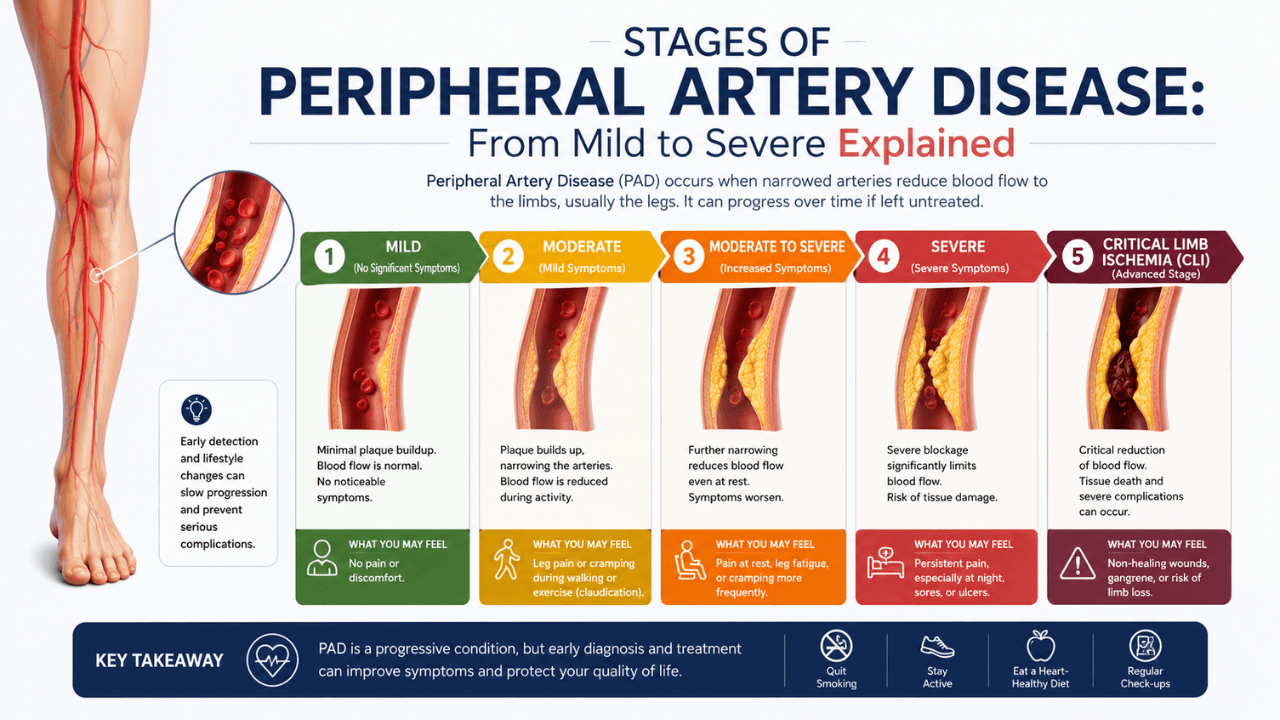
How Many Stages of PAD Are There?
When doctors talk about PAD stages classification, they most commonly use the Fontaine Classification System - a widely accepted medical framework that divides Peripheral Artery Disease into four progressive stages. Each stage reflects how much blood flow is restricted and how significantly it affects your daily life.
Here is a quick overview before we go deep:
Stage 1: Asymptomatic (No symptoms, but disease is present)
Stage 2: Claudication (Leg pain during walking or activity)
Stage 3: Critical Limb Ischemia / Rest Pain (Pain even while resting)
Stage 4: Acute Limb Ischemia / Tissue Loss (Wounds, gangrene, or tissue death)
Understanding these peripheral artery disease stages helps you recognize where you stand and what action to take.
Stage 1: Asymptomatic - When PAD Hides in Plain Sight
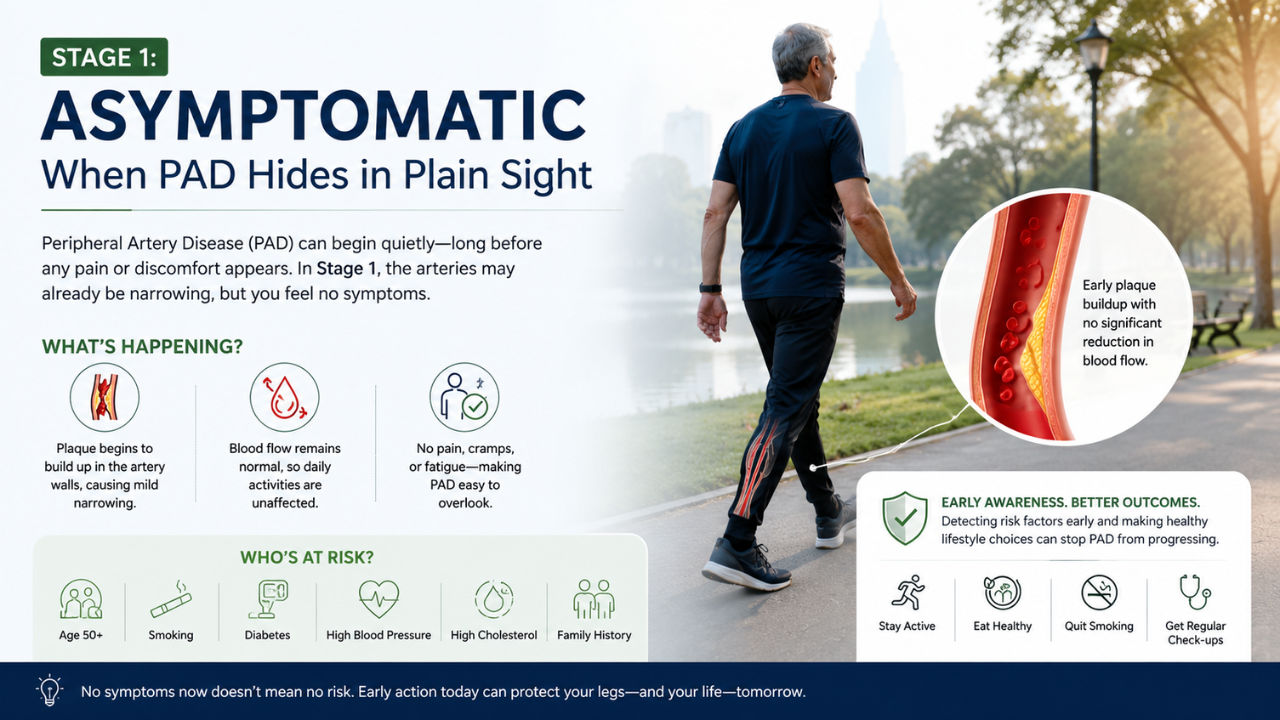
Stage 1 - Asymptomatic PAD The earliest and most overlooked of all the stages of Peripheral Artery Disease. No pain, no obvious symptoms - but the disease is already quietly progressing. |
What Is Happening Inside Your Body?
In this first stage of the PAD classification, plaque (a combination of fat, cholesterol, and other substances) has started building up on the inner walls of your arteries. The arteries are narrowing, but your body is still managing to push enough blood through. So you feel nothing - or almost nothing.
Many people at this stage are diagnosed accidentally during a routine checkup or a test done for another reason. Doctors may notice a low Ankle-Brachial Index (ABI) reading, which compares blood pressure in your ankle to your arm. A reading below 0.9 is a strong indicator of PAD even without symptoms.
Who Is at Risk at Stage 1?
Smokers or former smokers
People above 50 years of age
Diabetics, especially those with uncontrolled blood sugar
Individuals with high blood pressure or high cholesterol
Those with a family history of heart disease or stroke
Symptoms of Stage 1 PAD
There are technically no classic symptoms at this stage, which is exactly what makes it so dangerous. However, some patients in Gurgaon and Delhi NCR describe:
Occasional coldness or slight heaviness in one or both feet
A faint difference in skin color or temperature between both leg
Very mild fatigue in the legs after longer-than-usual walks
Important Note: Just because there are no symptoms does not mean PAD is not advancing. This is the best time to catch and manage it. Not all patients need surgery at this stage. Lifestyle changes and medications work very well. |
How Is Stage 1 PAD Diagnosed?
At Stage 1, the diagnosis of PAD focuses on early detection of reduced arterial blood flow before significant symptoms develop. The following assessments help identify underlying vascular changes and risk factors at the earliest possible stage.
Ankle-Brachial Index (ABI) test
Doppler Ultrasound of leg arteries
Blood tests to check cholesterol, sugar, and inflammation markers
Physical examination by a vascular specialist
Treatment at Stage 1
The goal here is to slow down or stop the progression of the stages of arterial blockage in the legs. Dr. Himanshu Verma typically recommends:
Quitting smoking immediately - the single most impactful step
Regular supervised walking exercises
A heart-healthy, low-fat diet
Medications to control blood pressure, cholesterol, and blood sugar
Antiplatelet drugs to prevent clot formation
Regular follow-up monitoring every 3 to 6 months
Stage 2: Claudication - When Walking Becomes Painful
Stage 2 - Claudication The most common stage at which patients first visit a vascular specialist. The leg pain comes when you walk and disappears when you rest - a pattern that feels confusing but is very recognizable. |
What Does Claudication Feel Like?
At this point in the peripheral artery disease stages, your arteries are significantly narrowed. When you walk, your muscles demand more oxygen-rich blood. But the blocked arteries cannot deliver enough. The result is a cramping, aching, or burning pain - typically in the calves, thighs, or buttocks. The moment you stop and rest, the pain fades because the demand drops.
Think of it like trying to drink through a straw that is half-crushed. During rest, a slow trickle is enough. But when you walk, and your muscles need more, that straw simply cannot keep up.
Stage 2 Is Further Divided Into:
Stage 2a: You can walk more than 200 metres before the pain kicks in (mild claudication)
Stage 2b: You cannot walk even 200 metres without pain (moderate to severe claudication)
Symptoms of Stage 2 PAD
Cramping pain in the calf, thigh, or buttock during walking
Pain that stops within a few minutes of rest
Legs feel heavy or tired during physical activity
Skin on the feet may appear pale or bluish
One leg may feel cooler than the other
Weak or absent pulse in the feet
What Causes This Progression?
The stages of PAD symptoms worsen when risk factors like smoking, diabetes, or high blood pressure are not controlled. The peripheral vascular disease stages progress faster in people who continue smoking or who are physically inactive.
Diagnosis at Stage 2
At Stage 2, diagnostic evaluation focuses on confirming the presence of arterial insufficiency and mapping the extent of vascular compromise during both rest and physical activity. The following tests are carried out to accurately identify blockages and assess circulation under stress conditions.
ABI with exercise (treadmill test to reproduce symptoms)
Colour Doppler Ultrasound
CT Angiography or MR Angiography (for detailed artery mapping)
Treatment at Stage 2
Most patients with Stage 2 claudication do not need surgery. Dr. Himanshu Verma focuses on the treatment of PAD through non-surgical options first:
Supervised Exercise Therapy: Walking programs specifically designed to improve leg circulation over time
Medications: Cilostazol, statins, antiplatelet drugs
Risk Factor Control: Aggressive management of diabetes, hypertension, and cholesterol
Lifestyle Modifications: Quit smoking, dietary changes, weight management
If symptoms significantly limit daily activities and do not respond to these measures, minimally invasive procedures like angioplasty or stenting may be considered.
Stage 3: Critical Limb Ischemia - When Pain Does Not Stop Even at Rest
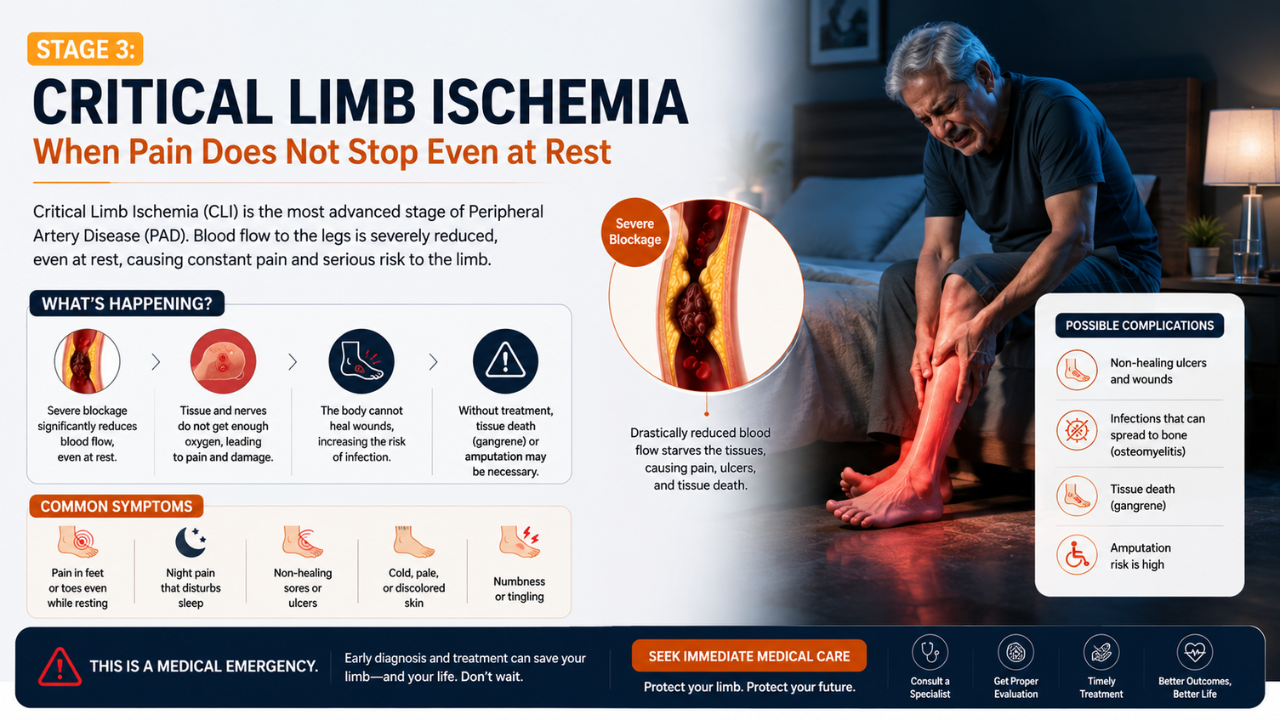
Stage 3 - Critical Limb Ischemia / Rest Pain This is a medical emergency zone. The blood supply to your leg is now severely compromised. Pain does not go away even when you lie down and rest. |
Why Does Pain Occur Even During Rest?
In the earlier PAD progression stages, your body could somewhat compensate for the reduced blood flow. By Stage 3, that compensation is no longer possible. Your leg muscles and tissues are not getting enough oxygen even when you are completely at rest. The pain is most severe at night and in the feet, because at rest, blood pressure drops, making the supply even worse.
Many patients describe this as a burning, throbbing ache in the feet or toes that keeps them awake at night. Some people hang their feet off the side of the bed for relief - gravity helps pull a little more blood downward.
Symptoms of Stage 3 PAD
Constant, severe pain in the feet or toes, even while lying down
Nighttime pain that disrupts sleep
Cold feet that feel numb
Skin appears pale, shiny, or bluish
Slow or absent healing of even small cuts or bruises
Leg hair may stop growing
Toenails become thick and brittle
How Urgent Is Stage 3?
Very urgent. Stage 3 in the stages of Peripheral Artery Disease classification is called Critical Limb Ischemia (CLI). If not treated promptly, it can advance to Stage 4 within weeks or even days. At this stage of PAD stages classification, the goal is to restore blood flow before tissue damage becomes irreversible.
Diagnosis at Stage 3
At Stage 3, prompt diagnostic assessment is critical to evaluate the progression of vascular insufficiency and prevent further deterioration. The following investigations are performed to assess blood flow, oxygenation levels, and overall systemic health.
Urgent Doppler Ultrasound
CT Angiography or Digital Subtraction Angiography (DSA)
Transcutaneous Oxygen Pressure (TcPO2) test
Complete blood workup
Treatment at Stage 3
At this level of arterial blockage in legs, intervention is usually needed. Dr. Himanshu Verma at Fortis Memorial Research Centre, Gurugram evaluates each patient individually. Options include:
Angioplasty and Stenting: A balloon is inflated inside the blocked artery to open it up; a stent holds it open
Surgical Bypass: A graft is used to reroute blood around the blocked section
Atherectomy: Plaque is removed using a tiny rotating device inside the artery
Medications for Pain and Clot Prevention: Pain management alongside medical therapy
Treatment depends on the condition, and Dr. Verma will discuss all options with you in detail before any procedure is planned.
Stage 4: Acute Limb Ischemia - When Tissue Begins to Die
Stage 4 - Acute Limb Ischemia / Tissue Loss The most severe of all the stages of Peripheral Artery Disease. Tissue is dying due to zero or near-zero blood supply. Gangrene, non-healing ulcers, and possible amputation risk are real at this stage. |
What Happens to the Limb?
By Stage 4, the stages of PAD symptoms have evolved into something visible and alarming. Ulcers appear on the toes, heels, or ankles - wounds that simply do not heal no matter how well you clean or bandage them. In severe cases, tissue begins to die, turning black. This is called gangrene.
Without immediate intervention, Stage 4 of peripheral vascular disease stages carries a high risk of amputation of toes, the foot, or even the leg below the knee.
Symptoms of Stage 4 PAD
Non-healing wounds or ulcers on feet, toes, or ankles
Dark discoloration or blackening of toes or skin (dry gangrene)
Foul-smelling wounds with discharge (wet gangrene, indicating infection)
Extreme, constant pain in the affected area
Swelling and warmth due to infection
Sudden onset of severe coldness, paleness, and loss of sensation (acute ischemia from a clot)
Is Amputation Always Necessary?
Not always. Dr. Himanshu Verma strongly believes that not all patients need surgery or amputation. Even at Stage 4, if treated in time, limb salvage is often possible through advanced vascular procedures. The critical factor is how quickly the patient seeks help.
Diagnosis at Stage 4
At Stage 4, immediate and comprehensive diagnostic evaluation is essential to assess the severity of the condition and guide treatment decisions. The following procedures are conducted to determine the extent of vascular damage and infection.
Emergency DSA (Digital Subtraction Angiography)
CT Angiography
Wound culture to identify infection type
Blood flow mapping
Treatment at Stage 4
This stage requires urgent, multidisciplinary care at a well-equipped centre like Fortis Memorial Research Centre, Gurugram. Treatment options include:
Emergency Revascularization: Restoring blood flow through angioplasty, stenting, or bypass surgery
Wound Debridement: Removing dead tissue to prevent infection from spreading
IV Antibiotics: If there is active infection or wet gangrene
Hyperbaric Oxygen Therapy: In selected cases, to help wounds heal
Amputation (Last Resort): Only when the limb cannot be saved despite all efforts
Treatment depends on the condition. Dr. Himanshu Verma always explores every limb-saving option before recommending amputation. Patients from across Gurgaon, Delhi NCR, Noida, and Haryana have avoided amputation through timely vascular intervention. |
Stages of Peripheral Artery Disease at a Glance
Stage | Name | Key Symptom | Urgency |
1 | Asymptomatic | No symptoms | Monitor and prevent |
2a | Mild Claudication | Pain after 200m walk | Medical management |
2b | Severe Claudication | Pain before 200m walk | Active intervention |
3 | Rest Pain (CLI) | Pain at night/rest | Urgent - days matter |
4 | Tissue Loss / Gangrene | Wounds, blackening | Emergency - hours matter |
When Should You See a Vascular Specialist?
Do not wait for symptoms to become unbearable. See Dr. Himanshu Verma if you notice any of the following:
Leg pain, cramping, or heaviness that comes on with walking
Foot or toe pain that worsens at night
Non-healing wound or ulcer on the foot or leg
One foot looking much paler or colder than the other
You are a diabetic above 50 and have never had your leg circulation checked
You are a smoker with high blood pressure or cholesterol
Patients from Gurgaon, Delhi NCR, Noida, Faridabad, and Haryana can reach Dr. Himanshu Verma at Fortis Memorial Research Centre for a detailed evaluation. Dr. Verma specializes in Peripheral Artery Disease Treatment in Gurgaon, offering expert diagnosis and advanced care to help you regain healthy circulation and quality of life.
Conclusion: Know Your Stage, Take Action Early
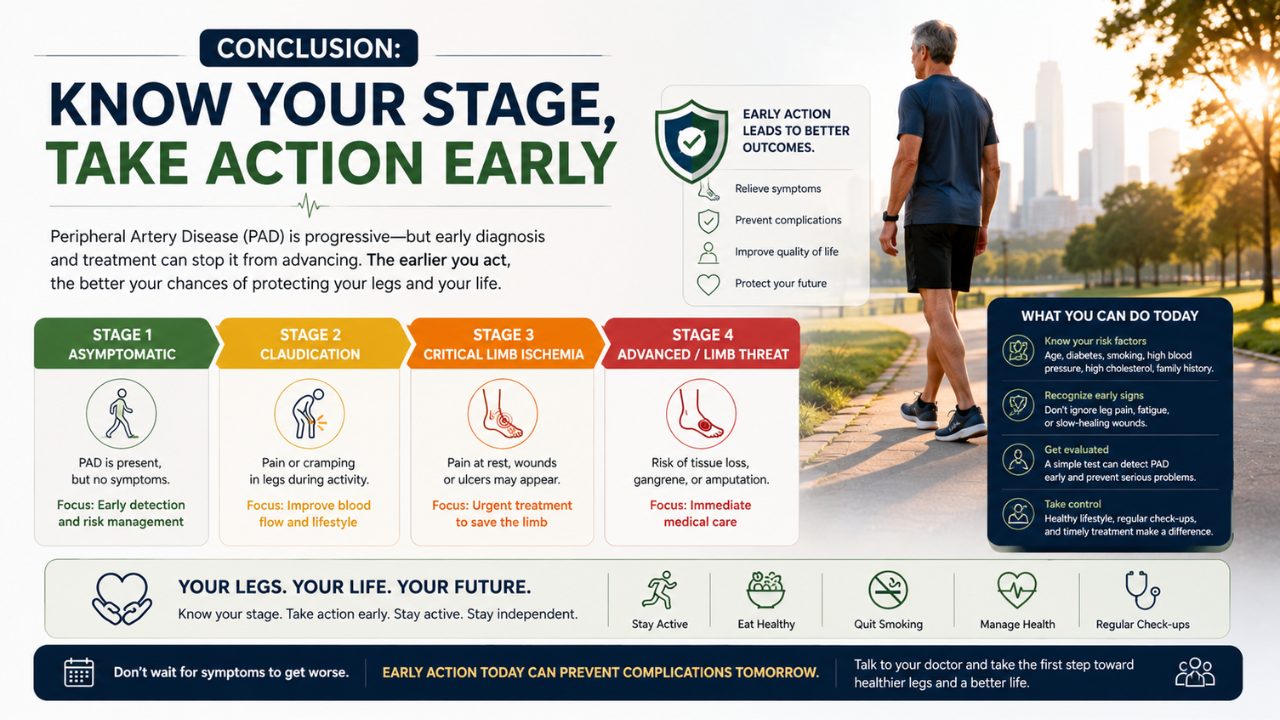
The stages of Peripheral Artery Disease are a roadmap. They tell you where the disease is, how fast it is moving, and what can be done about it. From the silent beginnings of Stage 1 to the urgent realities of Stage 4, there is a treatment plan for every patient at every stage.
What matters most is that you do not ignore the signs. Leg pain, cramps, cold feet, slow-healing wounds - these are not normal parts of ageing. They are your body telling you that blood flow to your legs is being affected.
Dr. Himanshu Verma at Fortis Memorial Research Centre, Gurugram, is committed to providing every patient from Gurgaon, Delhi NCR, Noida, and Haryana with a personalized, evidence-based plan that is explained in simple language and executed with compassion.
Whether you need a lifestyle plan, a medication review, or a life-saving procedure, remember: treatment depends on the condition. Not all patients need surgery. But every patient needs the right diagnosis at the right time.
Ready to Take the Next Step?
Do not wait until symptoms become severe. Early consultation with a vascular specialist saves limbs and lives.
Book Your Consultation with Dr. Himanshu Verma If you are experiencing leg pain, cramps, or numbness, do not wait. Early diagnosis can prevent serious complications. Phone / WhatsApp: 88268 33598 Email: varenyamvascular@gmail.com Fortis Memorial Research Centre, Opposite HUDA City Centre, Sector 44, Gurugram, Haryana 122003 Serving patients from Gurgaon, Delhi NCR, Noida, and Haryana |